Blog

Jim is a seasoned professional with over 36 years of experience in learning and development. He holds an MBA in Digital Transformation and an MSc in Learning Technology.

Why International Trainer Certification Matters More Than Ever.

The Learning & Development market is growing rapidly. At the same time, the barrier to entry has never been lower. Almost anyone can call themselves a trainer, coach, or facilitator. Certifications are everywhere. Visibility is easy. Credibility is harder. That is exactly why international trainer certification matters more than ever. I have been a member of the International Board of Certified Trainers (IBCT) since 2003. Recently, I joined its board. More than two decades of involvement have strengthened my belief that independent, international validation is not a luxury, it is a professional necessity.

Expertise Should Not Be Self-Declared

Experience is valuable. A strong network helps. A well-designed website increases visibility. But professional credibility requires more than self-positioning. International trainer certification means that your competencies, methodology, ethics, and professional conduct are assessed against independent standards. Not by your peers. Not by your marketing. But by a recognized international body. That creates:

  • Transparency
  • Trust
  • Cross-border comparability
  • A shared professional benchmark

In a globalized learning market, those elements are essential.

National Recognition Is a Start. International Standards Go Further.

Many countries offer national accreditations for trainers and learning professionals. That is valuable and often necessary. However, organizations operate internationally. Teams collaborate across borders. Digital learning solutions are deployed globally. Talent moves. International trainer certification provides:

  • Portability of professional credibility
  • Alignment with global quality standards
  • Recognition beyond one national framework

For trainers working with multinational organizations or diverse cultural contexts, this is a strategic advantage.

Certification Is About Systems, Not Just Individuals

Professional standards are not only about the trainer standing in front of a group. IBCT certifies individuals but also accredits training facilities. Why does that matter? Because learning quality is systemic. It includes:

  • The didactic setup of the learning environment
  • Technological infrastructure
  • Safety and accessibility
  • Professional learning conditions
  • The overall experience design

A visually impressive training room does not guarantee quality. A certified learning environment supports measurable learning outcomes. International standards raise the bar for both professionals and the environments in which they operate.

From Claims to Evidence

In many organizations, I see strong ambitions: better leadership, stronger digital capabilities, AI literacy, compliance excellence. But how is quality demonstrated? International trainer certification forces clarity and discipline. It requires you to:

  • Make your methodology explicit
  • Define measurable standards
  • Document impact
  • Operate within ethical guidelines

It shifts the conversation from “we believe we deliver quality” to “our quality is independently verified.” In a world where AI can generate content instantly and the market is saturated with providers, evidence-based credibility becomes a differentiator.

Professionalizing Learning & Development Globally

Learning & Development has matured as a strategic function. Yet globally, professional standards remain fragmented. If we want organizations to treat L&D as mission-critical, we must uphold internationally recognized standards ourselves. International trainer certification contributes to:

  • Strengthening the credibility of the profession
  • Raising international benchmarks
  • Encouraging continuous professional development
  • Protecting clients and learners

My (non-paying) role on the IBCT board is not about a title. It is about contributing to the further professionalization of our field at an international level.

A Question Worth Asking

If you work as a trainer or L&D professional, consider:

  • Is your expertise independently validated?
  • Is your certification internationally transferable?
  • Can you demonstrate your standards beyond your own market?

International trainer certification is not the goal. Trust is. And trust is built on independent standards, consistent quality, and professional accountability.

A Moment to Reflect on a Meaningful Year

Come to a close

As the year comes to a close, it is a natural moment to pause, reflect and appreciate what has been achieved together. Over the past year, I had the privilege of working with the Municipality of Amsterdam on several impactful projects. Together with dedicated and talented colleagues, I contributed to the development and delivery of new videos for the Ambtelijk Vakmanschap e learning program, the renewal of the learning curriculum, and the creation of an online learning and development guide to support municipal employees in their daily work, growth and professional development.

These initiatives were not simply about producing learning materials. They were about strengthening craftsmanship, supporting responsible public service and helping people grow in their roles. They were about collaboration, clarity of purpose, and the shared ambition to deliver reliable and high quality services to the city and its residents. I am grateful for the trust, the teamwork and the positive energy I experienced throughout these projects.

Looking Ahead with Energy and Optimism

The holiday season provides time to recharge, reflect on what went well and prepare for new ambitions and opportunities. I look forward to continuing to support organizations and professionals in learning, leadership, change and digital transformation, and to working with teams that want to move forward with clarity, confidence and purpose.

I wish everyone a warm, successful, and enjoyable holiday season and a healthy, inspiring and successful 2026. May it be a year of learning, growth and meaningful results.

Greetings and I hope we meet again in 2026!

 Jim


New Roles in Learning & Development: What Modern Organisations Must Prepare For

The rise of new L&D roles: from drone trainer to AI coach

Organisations are changing fast. Technology accelerates, teams become hybrid and the pressure to stay agile increases. This creates new Learning & Development roles that did not exist a few years ago. One example is the Training & Development Specialist – Drones at the ANWB. A role once unimaginable, now a logical need.

Below are several new L&D roles increasingly appearing. They show how broad the field becomes and how deeply it connects with digital transformation.

AI Learning Coach

AI systems become standard colleagues. Yet employees often struggle with prompting, critical assessment and ethical use. The AI Learning Coach supports teams in using AI safely and effectively.

Immersive Learning Designer (VR/AR)

VR and AR become mainstream, especially for safety, crisis training or leadership simulations. The designer builds scenarios, scripts and practice situations.

Skills Architect

Skills-based organisations are growing. The Skills Architect creates structure in competencies, roles and learning paths.

Digital Transformation Trainer

This role goes beyond explaining software. It focuses on digital behaviours, smarter workflows and adoption of new ways of working.

Ethics & Compliance Learning Specialist

With AI Act, AVG and integrity on the agenda, this role turns complex regulation into accessible learning.

Human-Robotics Trainer

In logistics, healthcare and industry, people collaborate more with robots. This trainer guides teams in safe and effective human-robot interaction. These new roles prove that L&D moves towards strategy, data, technology and behavioural change. For organisations it means innovation. For L&D professionals it means opportunities.

Why this is important

a. Work is changing faster than traditional L&D can keep up.
Technologies such as AI, robotics, VR/AR and data-driven systems reshape jobs at high speed. Classic L&D roles focused on classroom training are no longer enough. Organisations need specialists who understand how people learn while also grasping the complexity of modern tools and workflows.

b. Skills become the new organisational currency.
Instead of fixed job descriptions, organisations move towards dynamic skills ecosystems. New roles like Skills Architect and Learning Data Analyst help define, track and grow the skills organisations actually need. This is essential for internal mobility, workforce planning, and future readiness.

c. Digital transformation requires behavioural change.
Most digital projects fail not because of technology, but because people do not change behaviour. Roles such as Digital Transformation Trainer and AI Learning Coach focus precisely on closing this gap: helping teams apply new ways of working, not just understand them.

d. Regulation and ethics demand new learning interventions.
With the rise of AI Act, privacy requirements, compliance and integrity risks, organisations need learning roles that translate rules into practical behaviour. This gives birth to roles like Ethics & Compliance Learning Specialist.
It’s no longer optional — it’s part of organisational licence-to-operate.

e. L&D moves from cost centre to strategic partner.
Data-driven roles such as Learning Data Analyst prove impact, performance links, and ROI. This shifts L&D from “training provider” to “business value creator.”

f. Talent scarcity demands smarter development.
Many sectors face shortages, high turnover and ageing workforce.

New L&D roles help organisations:
• keep skills relevant
• increase retention
• guide career transitions
• support younger staff entering high-complexity environments.

In summary

The rise of new L&D roles from AI Learning Coach to Immersive Learning Designer signals a shift in how organisations learn and transform. Work changes too fast for traditional L&D. Skills become the core of workforce strategy. Digital transformation requires behaviour change, not just tools. Regulation demands ethical and compliant workflows. Data makes learning measurable. Together, these roles turn L&D into a strategic engine that drives innovation, growth and future readiness.

When The Story Suddenly Changes

Introduction

Sometimes you walk out of a meeting convinced that you have just landed the assignment.
The energy feels right, everyone nods, and the discussion ends with clear enthusiasm. You leave the room already thinking about the next steps, who to involve, what to prepare, and how to deliver value quickly. For a moment, everything seems to line up perfectly. And then, a few days later, an unexpected message arrives. It might be an email that starts friendly but ends differently. “We have decided to go in another direction.” You read it once, then again, trying to make sense of it. The tone is polite, the reasoning vague. You sit back for a moment, slightly stunned, wondering what just happened.

The situation

Did you misread the situation? Did you hear what you wanted to hear? Were they not as clear as they seemed, or were you already halfway into the solution before they were even sure about the problem? These moments leave you with that strange feeling of doubt. You start replaying the conversation in your head. You remember the smiles, the nods, the signals that felt positive. And you ask yourself whether the story changed afterwards, or whether it was never really what you thought it was in the first place.

Clarity

In my work with organisations, I have learned that clarity is rarely as solid as we believe. It is not a fixed point. It shifts with context, politics, timing, and even with the mood in the room. People often speak in half-truths without meaning to. They are balancing between what they want, what they can say, and what is still uncertain inside their own organisation. That is why you sometimes walk into a meeting where everyone agrees but walk out of a completely different one a week later. Priorities change. New information appears. Someone higher up takes a different view. And what once seemed like a green light turns out to be only a polite handshake at the starting line.

Do not take it personal

It is easy to take that personally. To think you missed something or that you did not listen carefully enough. But more often than not, it is simply how organisations breathe. They move, they shift, and the story evolves. What was true on Monday may no longer be true by Thursday. The only real safeguard is curiosity. Asking one more question than feels comfortable. Not to prove a point, but to explore what sits beneath the surface. What is driving this request? What makes this important now? Who else is involved in the decision? What could make this change tomorrow? These are not questions that guarantee success, but they keep you connected to reality. They help you read not only the words but the silences between them.

In closing

Over the years I have learned that the moment of surprise — when a conversation suddenly turns, is not necessarily a sign of failure. It is a reminder that we are dealing with people, not processes. And people change their minds, especially when things get complex. So, when the story changes, I try to resist the instinct to close the door or blame myself for misunderstanding. Instead, I take it as a moment to pause, reflect, and prepare better questions for next time. Because real understanding does not come from hearing what people say. It comes from staying curious when the conversation takes a turn you did not expect.

AI Means the Sky Is Not Your Limit Anymore

Introduction

We are entering a new era where the boundaries between professional roles are fading. In the past, a consultant focused on strategy, a trainer focused on learning, and an L&D professional built program. Coding, design, or data were skills you left to specialists. Skills like stakeholder management or learning agility were seen as long-term developmental journeys. With the rise of artificial intelligence, these borders are dissolving. AI lowers barriers and unlocks capabilities that once required years of training or practice. Suddenly, one professional can reach into multiple fields at once.

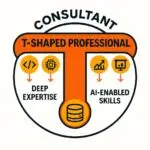
This is not about replacing experts. It is about expanding your own reach and becoming a T-shaped or even M-shaped professional. You still have your core expertise, but AI allows you to branch out horizontally into coding, design, storytelling, analysis, and even soft skills such as agility or communication. In other words: with AI, the sky is not your limit anymore.

Examples on how AI expands roles and skills.

Example 1: Coding without being a programmer

Writing code once demanded years of training. Now AI can generate working scripts or prototypes in seconds. With Articulate Rise’s new Code Block (beta), you can use AI to insert HTML, CSS, or JavaScript and create richer, more interactive learning. A trainer or L&D professional can now directly enhance the learner’s experience.

  • Examples of tools: ChatGPT (Code Interpreter or Advanced Data Analysis), GitHub Copilot, Rise Code Block (beta).

Example 2: Graphic design at your fingertips
Strong visuals bring messages to life, but design was once the domain of specialists. Today AI makes professional images and layouts accessible to everyone. For consultants and trainers this means presentations, e-learning, and reports can become visually compelling without outsourcing.

  1. Examples of tools: MidJourney, DALL·E, Canva Magic Tools.

Example 3: Data analysis and insight
Where data used to be the territory of statisticians, AI now makes it approachable for everyone. It can clean, analyze, and visualize complex information, giving consultants and managers in digital transformation immediate insights. This makes advice more evidence-based and decisions faster.

  • Examples of tools: ChatGPT Advanced Data Analysis, Google Gemini, Tableau with AI.

Example 4: Smarter presentation development.

Presentations remain at the heart of consulting and training yet creating them can be time-consuming. AI tools can now generate entire decks with structure, visuals, and story flow. You provide the ideas, and the AI delivers a draft to refine. That means more focus on engagement and less on formatting.

  • Examples of tools: Beautiful.ai, Tome AI, Microsoft Copilot in PowerPoint.

Example 5: Project management and communication.

Managing complexity is easier with AI. It can create task lists, track progress, and generate meeting notes automatically. For consultants and interim managers this saves valuable time and shifts attention to people, strategy, and results.

  • Examples of tools: Otter.ai, Notion AI, ClickUp AI.

Example 6: Accelerating difficult-to-learn skills.

Beyond hard skills, AI also supports the growth of softer, often harder-to-master capabilities. Learning agility can be enhanced by simulating real-world scenarios or providing instant feedback. Stakeholder management can be practiced with AI role-plays, exploring different perspectives before a real meeting. Even critical thinking can be trained by using AI to challenge your assumptions, generate counterarguments, and surface hidden biases. These skills usually take years to develop, but AI gives professionals a safe space to practice and refine them faster.

  • Examples of tools: Claude for simulated dialogues, AI-powered coaching platforms, adaptive learning tools like Docebo or LearnAmp.

From T-shaped to limitless

What emerges from all this is a new professional identity. The consultant, trainer, or L&D professional no longer works only within the walls of one specialty. With AI, you extend upward into the horizon of possibility. You remain anchored in your deep expertise, the vertical line of the T, but your horizontal reach is now wider than ever, sometimes spanning multiple depths and creating an M-shape. And above it all lies the sky. Not as a ceiling, but as a wide-open space of opportunities. AI enables you to connect disciplines, bridge knowledge, and even accelerate the development of complex soft skills.

With AI, the sky truly is not your limit anymore.

The 5 Most Effective Change Management Models for Successful Transformation

Introduction

Change is never a one-size-fits-all journey. Over the years, I have guided organisations through transformations in banking, government, and industry. What I have learned is simple: successful change requires a balance between structure and people, between business goals and human experience.

ADKAR

One of the most practical models is Prosci’s ADKAR. It stands for Awareness, Desire, Knowledge, Ability and Reinforcement. ADKAR breaks change down into concrete steps that individuals must go through to adopt new behaviours. In my own projects, ADKAR often acts as a diagnostic tool: if a programme stalls, I can quickly see whether the issue lies in lack of awareness, insufficient skills or missing reinforcement.

Kotter

Another powerful approach is Kotter’s 8 Steps, which emphasises leadership and the power of momentum. From creating urgency to embedding change in the culture, the steps provide a roadmap for large-scale transformation. In one digital transformation project, I used Kotter’s principles to create short-term wins, visible improvements that convinced sceptical managers to support the wider programme.

Lewin

Kurt Lewin already described in the 1940s that change moves in three phases: unfreeze, change, refreeze. It sounds simple, but it captures the essence: people need to let go of old habits before they can embrace new ones. I often use Lewin as a metaphor when explaining to teams why rushing to implementation without preparation rarely works.

7S

The McKinsey 7S framework reminds us that change only sticks if both the “hard” and “soft” sides are addressed. Strategy, structure and systems need to be aligned, but so do style, staff, skills and shared values. In practice, I use the 7S to map out interdependencies. For example, introducing new systems without adapting leadership style or skills usually leads to frustration instead of progress.

Transition

William Bridges’ Transition Model makes a valuable distinction between change, which is external, and transition, which is internal. People go through three stages: ending and letting go, the neutral zone, and the new beginning. This model is particularly helpful in sensitive transformations where emotions play a big role, such as during reorganisations or mergers. I have seen leaders underestimate the letting go phase, which often creates hidden resistance later.

In Summary

What sets these models apart is their unique focus. Prosci is practical and diagnostic at the individual level. Kotter provides energy and leadership at the organisational level. Lewin offers a simple yet powerful foundation for pacing change. McKinsey highlights systemic alignment across the organisation. Bridges reminds us that people need emotional guidance, not just new processes.

From my perspective, the true value lies in combining them. No single model covers every angle. In digital transformations, I often mix ADKAR for adoption, Kotter for urgency and 7S for organisational alignment, while always keeping Bridges in mind to support people emotionally. Change is both a science and an art. These models give structure, but success comes from knowing when to use which lens. As a change professional, I see my role as bridging the business, organisational and human dimensions, because only then does transformation become sustainable.

Other articles